Redefining Accessibility: How a Deep Tech AI Agent Eradicated Audit Bottlenecks and Bridged the Gap Between Engineering and the C-Suite
Modern enterprise software does not scale by simply generating more bug reports; it scales by providing actionable intelligence. As the CEO & Founder of Kelora, I led the development of Kelora Accessibility Intelligence—an Enterprise-grade Deep Tech SaaS. By engineering an autonomous AI Agent capable of bypassing complex enterprise security protocols to simulate real human behavior, we transformed weeks of manual accessibility audits into a minutes-long automated value stream.
The Challenge: The Illusion of Compliance and Operational Bottlenecks
Managing digital accessibility at an enterprise scale is fundamentally broken. Before our intervention, the standard audit process was a severe operational bottleneck. Relying on basic scanners yielded fragmented data, and conducting thorough manual tests using screen readers took weeks.
Furthermore, standard automated tools face a critical barrier: modern enterprise e-commerce platforms are shielded by robust Web Application Firewalls (WAF), such as Akamai. Standard bots get blocked, rendering automated audits useless on production environments. This resulted in a massive disconnect: C-level executives lacked clear visibility into compliance risks, while developers were bombarded with cryptic error codes lacking context. We needed a paradigm shift—from passive scanning to proactive, human-emulating intelligence.
Solution Architecture:
The Kelora Deep Tech Ecosystem
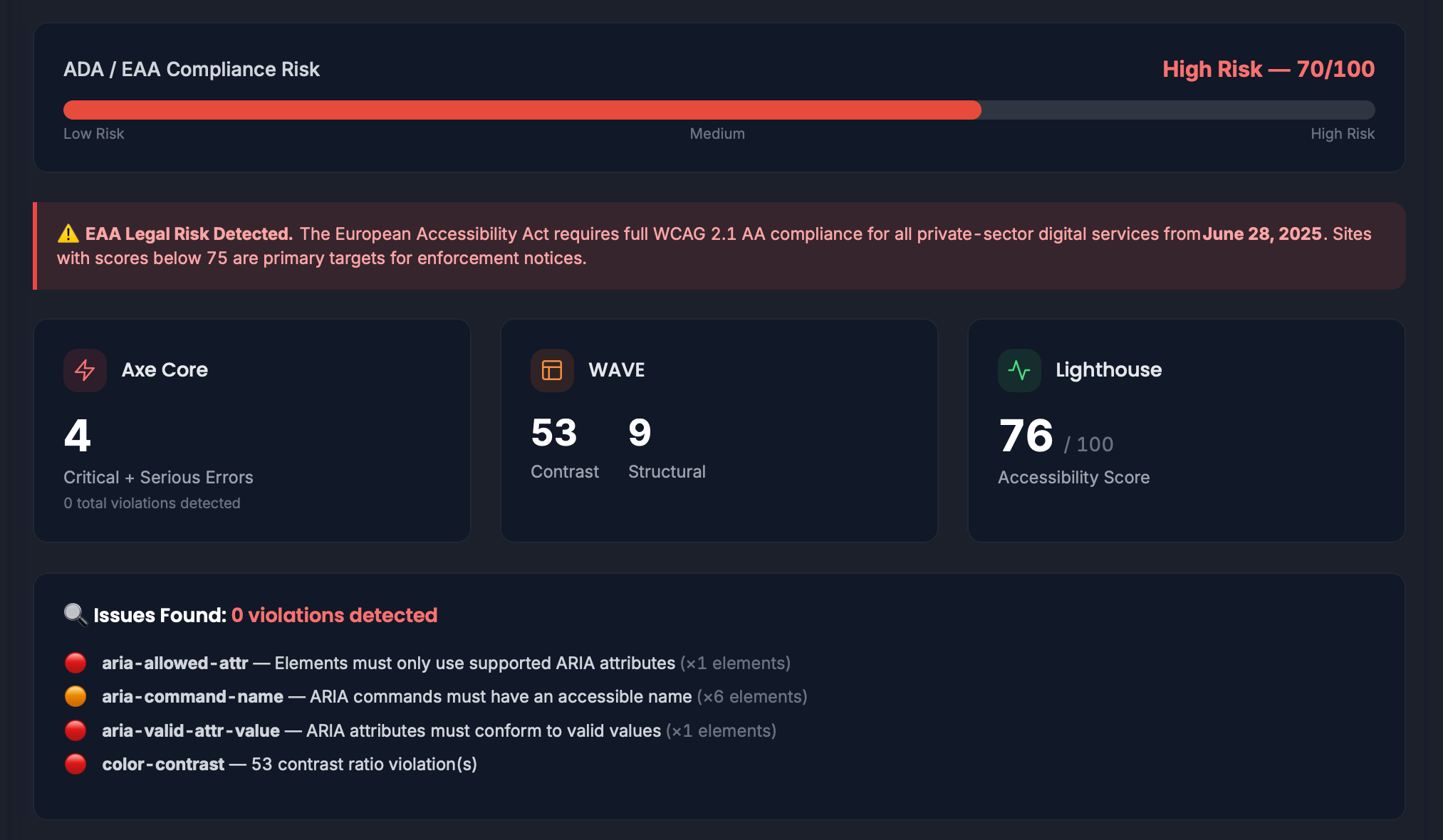
Instead of building just another wrapper around existing tools, we engineered a robust, multi-layered architecture powered by a FastAPI backend. Our unified pipeline integrated industry standards (Axe, WAVE) with our proprietary geometric Tab-Trap system, alongside the AccessiDOC module (leveraging VeraPDF, PyMuPDF, and AI Vision for document compliance).
However, the true breakthrough was our Autonomous Assistive AI Agent:
Bypassing Enterprise WAFs: To audit real-world e-commerce, we had to penetrate enterprise-grade defenses. Using ScraperAPI (REST, render=true, premium=true) coupled with a custom BeautifulSoup parser, we successfully bypassed Akamai's protections on major platforms like Lyreco.
Emulating Human Empathy: We didn't just scrape HTML; we fed it into the claude-sonnet-4-6 model, prompting the AI to simulate a visually impaired user navigating via an industry-standard screen reader.
Contextual Problem Solving: Even when the website lacked proper ARIA labels and alt-texts, our Agent successfully identified the complex navigation path to a specific product (A4 paper). It proved that AI can use contextual reasoning to bridge the gap where standard code compliance fails.
Breaking the Resistance:
From Raw Data to Actionable UX
With the technological foundation secured, we pivoted our strategic focus from pure code to business logic, UX, and scalability. We are currently deploying three core growth pillars to maximize our product's market fit:
Actionable Remediation (The AI Consultant): We shifted from merely pointing out flaws to providing ready-made engineering solutions. Instead of a vague "missing label" error, Kelora delivers specific directives: "Adding aria-label='Search' here will save a screen-reader user 5 seconds per task." This eliminates developer friction.
Global Scalability (Full English Framework): We rebuilt the core screen reader simulation engine, transforming system prompts and structural outputs (e.g., [HEADING], [LINK]) into a fully English-based architecture, positioning Kelora for international Enterprise deployment.
UX "Prompt Pills" for Product Owners: To combat "blank page syndrome," we designed an
intuitive interface utilizing pre-configured task buttons. Product Owners can now initiate complex, multi-layered audits with a single click (e.g., "Find the cheapest A4 paper" or "Subscribe to the newsletter"), making advanced AI accessible to non-technical stakeholders.
Business Results:
Time is Currency
The deployment of the Kelora AI ecosystem delivered an immediate and measurable Return on Investment:
Radical Time Reduction: We slashed the lead time required for comprehensive accessibility audits from several weeks to mere minutes. Real-time, complex analyses now run in the background.
Cross-Departmental Alignment: By translating raw technical debt into clear Executive Summaries for the Board and actionable, copy-paste code snippets for the engineering teams, we eliminated organizational silos.
Elevated ROI: Faster audits mean faster remediation. Kelora is no longer just a compliance tool; it is a foundational pillar for delivering barrier-free, high-converting digital products, ensuring that no user—and no revenue—is left behind.